2009
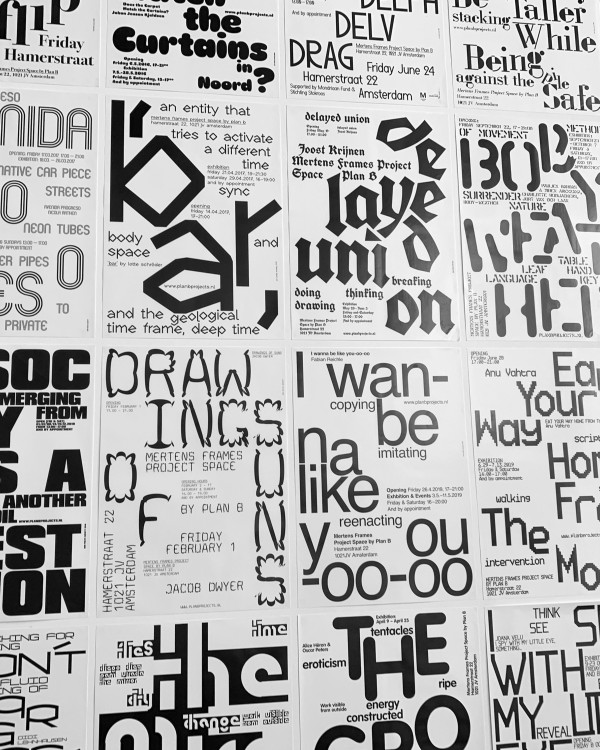
Invitations for the exhibition space A4 in Amsterdam.
Poster for a series of performances and the opening of the final exhibition of Antonis Pittas’ residency project in Den Helder.
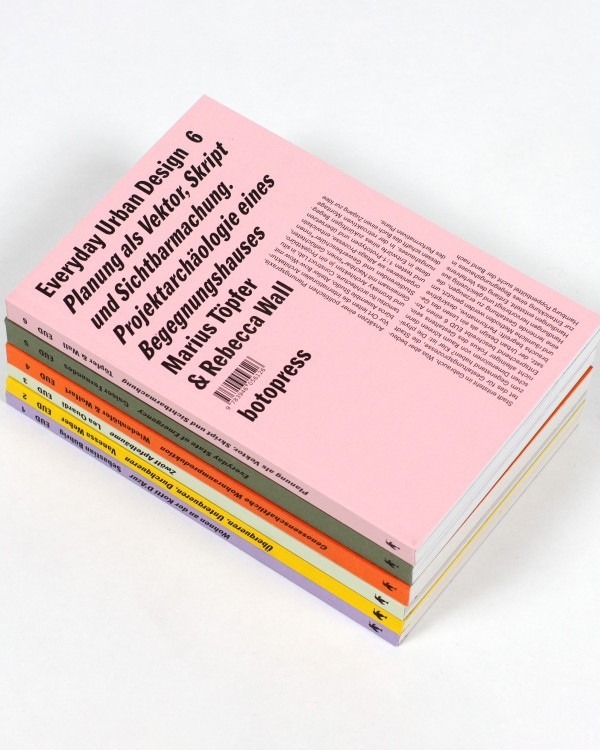
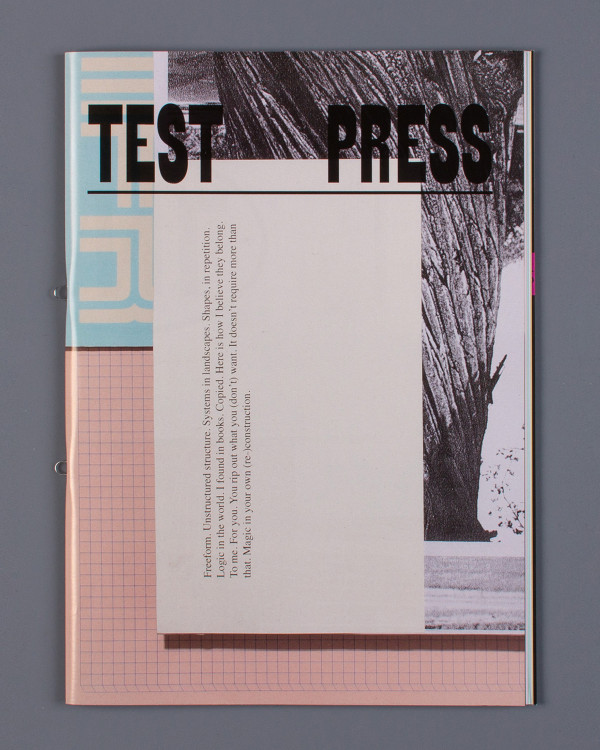
Working on a series of publications for OCCII in Amsterdam we want to investigate into new models and possibilities of production and distribution. (14)
Typographic identity for Swedish Style -- a non-profit organisation supporting Swedish design in different medias on an international level.
Record cover for Amsterdam lo-fi project Empire Cheese. This 7" entitled ‘Efficient Use of Space’ is released by Knife Slits Water records.
Traces of faces – the true Bontepike story.
2008
Posters and invites the ‘End of the Year Party’ at the Jan van Eyck Academy in Maastricht, 2008.
We designed and printed our own business cards and letter heads. The type is set in 16 pt Times and printed with letter press at the Rietveld Academy in Amsterdam with help from Alex Barbaix. (13)
We printed a poster at letter press workshop THE ARM in Brooklyn, New York during our visit in September, 2008.
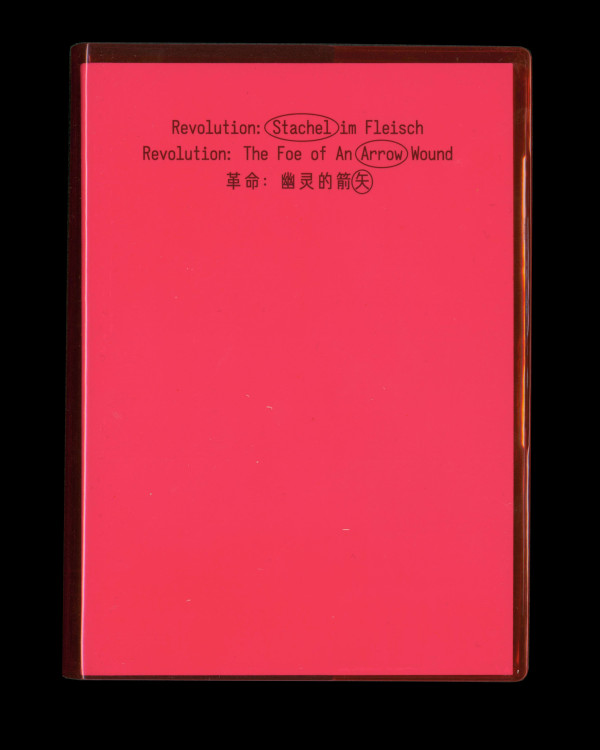
For ten days we worked and lived in an abandoned apartment building in Hoyerswerda in Eastern Germany and made a catalogue for the European Postgraduate Residency program that took place there during the summer.
A1 double–poster printed for the release party of The HOLIDAY Session in Summer 2008.
T-shirt with the five most fundamental questions one should ask oneself in any design related process. When put on a T-shirt they become questions about life in general. Why, how, when where, what? Popular culture meets philosophical thinking if you want. (12)
Poster for ‘Graphic Design Festival Breda’. We published a work by Paul Gangloff, proposing archetypes for the DIN series from A1–A8. (11)
Poster for Cologne based band PTTRNS.
Twelve inch record sleeve for Stockholm based band ‘The Je Ne Sais Quoi’. The original vinyl was used as a printing plate, reversing the vinyl production process onto the sleeve. (10)
Graphic identity for fashion designer Ulrika Sandström. The design is based on her name and the way it can be written in different ways; Ulrika Sandström, U. Sandström, Ulrika S., etc.
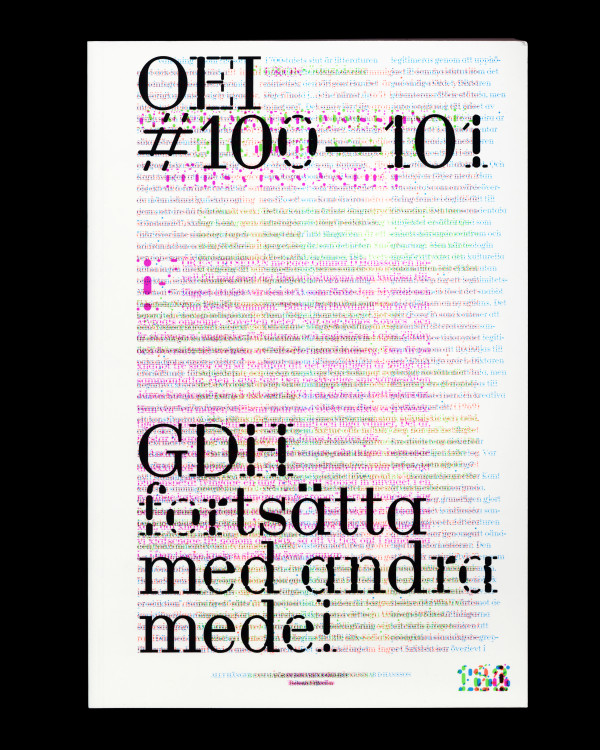
Bimonthly fanzine in collaboration with Tomas Adolfs, Staffan Björk, Orpheu De Jong, Kalle Mattsson, Tarja Szaraniec and Monica Tormell. Upcoming issue: The PSYCHEDELIC Session, release on date yetto be announced at Plan B, Herengracht 32, Amsterdam. (09)
Poster printed for the release party of The COLO(U)R Session.
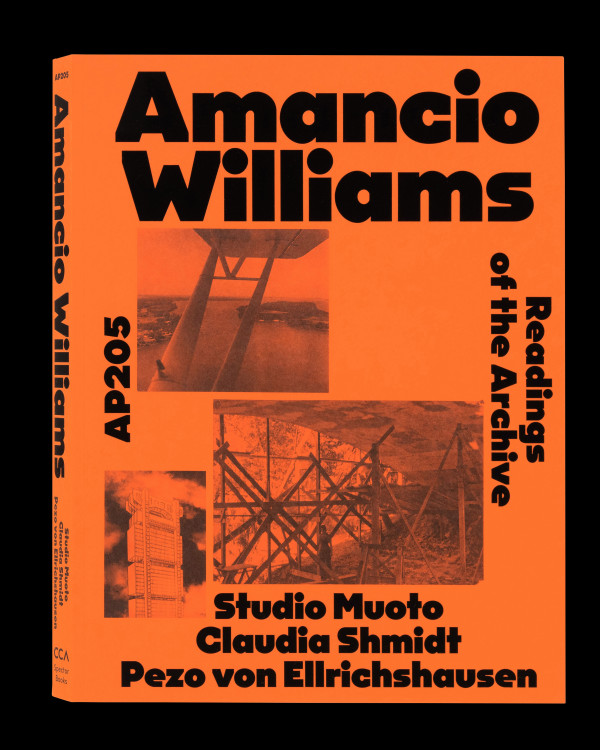
“The book features nine of their most ambitious projects so far: films, installations, and photographic works that focus on the dismantling, re-allocation, or re-appropriation of once highly idealistic modernist architecture, and the implications of such changes.
(…)
2007
Exhibition catalogue for Dutch artist Gerald van der Kaap. The catalogue is an edit of his archive, a collection of images in a specific order. (08)
Posters and T-shirts for an exhibition on Andy Warhol at KS1/K-Swiss Amsterdam. The gossiping in Warhol’s diary writings, the power in this kind of language and how it can make relations between people becomes the element for a series of posters and T-shirts. (07)
Yearbook for the Jan van Eyck Academy, Maastricht, 2007. The structure of the year was taken very literally as the concept for the design: each day of the year corresponds with one page in the book. If nothing was going on, according to the official program, the page was left blank. (06)
‘Research & Practice’ is a publication presenting the work of five graduate students from different disciplines within art and design at Konstfack Department of Interdisciplinary Studies in Stockholm.
Look book for fashion designer Ulrika Sandström and her autumn/winter collection 07-08 ‘Confetti’. 24 images are placed in a sequence and a new image follows directly after the previous one. Naturally the formats generates the croppings of the images.
Invitations for ‘We Are Going Underground’, Stockholm and Tokyo, 2007. The exhibition is an alternative platform for designers to show their work in a more inspiring environment in contrast to the big fairs.(05)
Seven inch record sleeve for the Cologne based outfit PTTRNS. By shifting the stamped out circles of the cover and the inner sleeve, all parts of the sleeve are shown at once, the sleeve designs itself. (04)
2006
This book – designed in 2006 for the Gerrit Rieveld Academy in Amsterdam – proposes an interdisciplinary take on art education and blurs out the borders between the different disciplines.
A magazine for and about the NDSM Wharf in the north of Amsterdam, an old ship construction factory which now provides studio space for artists and designers. The magazine was released in 4 issues, each of them setting out with another aspect of the theme non-profit and approaching editorial work and design in a different way. (03)
Business card for graduate student. Who am I? What can I do? What do I want to do? The first published work for Our Polite Society is a series of business cards that questions the identity of the graphic designer and use the title Counselling rather then Graphic Designer. On the back side a text informs about the past, present and future of the designer. (02)
2005
Re-enactment of a kidnapping box originally designed by by the second generation of the Red Army Fraction in 1976. (01)
|
(14) The OCCII (Onafhankelijk Cultureel Centrum In It) is a venue for alternative and independent music in Amsterdam, the Netherlands. The organization is mostly run by volunteers and has its roots in the squatting movement; the building was squatted in 1984 and “legalized” in 1989. Next to the concert hall, there's also a café (called the Kasbah), a restaurant (called MKZ), a library (Bollox), a theatre for children (Kinderpret), a bike workshop (Farafina), a sauna (Fenomeen), rehearsal studios, and a big courtyard.
— The building the OCCII resides in was built as a horse tram garage with stables in 1883/84 by architect Abraham Salm (1857-1915), who also designed (together with his father G. B. Salm) the buildings where popular commercial venues Melkweg and Paradiso now operate.

— The OCCII has no central programming, instead there are several programming groups that set the agenda. Some of these groups are Le Club Suburbia (mostly indie and post-punk), Hex (new wave and gothic), Muziek Kapot Moet (experimental music, electronic, noise, weird pop), Spellbound (electronic, dance), The Real Amsterdam Underground (punk, hardcore, crust) and Cool Schmool (dance, indie, riot grrrl, mostly female fronted).
— www.occii.org
(13) “A business card makes up one of the most important pieces in your consultant marketing kit. You typically hand over a card just moments after making an important connection. If that important contact receives a card with perforated edges, a bit of an inkjet smudge, slightly off-center wording, and a run-of-the-mill design, how do you think you’ll look to them? Will they take you seriously? Will they believe you’re really a consultant or will they wonder if you just whipped up these cards to hand out in emergencies? (...) So, if you want to look professional, don’t create your own business cards. Invest in them and improve your return on investment.”
— www.consultantjournal.com
(12) “We don’t see our work as art; we don’t see our work as making beautiful things. It is the result of social movement. It is not fashion or a special view of art. We try to establish our connection with the social situation in our work … The answers to our problems must be the questions: Why, how, when where, what?”
— Modified excerpt from a quote by Paul Schuitema from the book ‘What is a designer’ by Norman Potter
(11) “(...) Could honoured wellborn not tell me, where the forms of our paper makers are produced, or whether they, which I doubt, make their own? I once gave an exercise to a young Englishman, whom I taught in algebra, to find a sheet of paper for which all formats (forma patens, folio, 4, 8 and 16) are similar to each other. Having found that ratio, I wanted to apply it to an available sheet of ordinary writing paper with scissors, but found with pleasure, that it already had it. It is the paper on which I write this letter. The short side of the rectangle must relate to the large one like the side of a square to its diagonal.

This form has something pleasant and distinguished before the ordinary. Are these rules given to the paper makers or has this form spread through tradition? (...)”
— Excerpt from G. Lichtenberg’s letter to J. Beckmann, Göttingen, 25. Oct. 1786
(10) The first step in the record pressing process is the creation of the master disk, or acetate. The plater coats each acetate with a thin layer of silver which is then electro–plated with nickel. When this plate is separated from the acetate, the metal that was facing the disk now has ridges where the grooves were. This plate is called the father. The father plate is oxidized, and plated again. The resulting plate, when separated from the father, becomes a metal duplicate of the acetate, with grooves again. This plate is called the mother plate and is shelved for future use.

One father can produce 10 mothers, and one mother can produce 10 stampers. One stamper can produce about 1000 vinyl records. Therefore, this three step process can produce up to about 100,000 vinyl records before remastering.
(09) “The Session manufactures theme–zines in the finest DIY spirit, serving serious readers through a distribution network consisting of dealers. (...) The Session will favourize, focus and execute. It will continue to be committed and maintain a strong balance sheet with an anarchistic yet anal leadership.”
(08) A pamphlet is an unbound booklet (that is, without a hard cover or binding). It may consist of a single sheet of paper that is printed on both sides and folded in half, in thirds, or in fourths (called a leaflet), or it may consist of a few pages that are folded in half and stapled at the crease to make a simple book.


Pamphlets are very important in marketing as they are cheap to produce and can be distributed easily to customers. Pamphlets have also long been an important tool of political protest and political campaigning for similar reasons.
— Wikipedia
(07) “Bianca and Halston seem like they’re a couple now, they really do. It’s like a romance. But Bianca is so upset about Mick, and I’m surprised that she is, because she could get somebody rich in a minute. Somebody said to Halston, ‘Why don’t you marry Bianca?’ and he put his hands on his hips and said, ‘Because I’m the hostess here.’
— And then we all went over to a place called the Ice Palace on 57th and Sixth. It’s lesbians and hustlers. Bianca was dancing around, but she’s so unhappy, and she and Halston were trying to get Jed to go home with them, and they were asking me if this was okay. She said, ‘Nobody likes me.’ Everybody was wet from drinks getting spilled on them.”

— ‘The Andy Warhol Diary’, Monday, January 2, 1978
(06) Year 2007 (MMVII) was a common year starting on Monday of the Gregorian calendar in the 21st century.

The year 2007 was designated:
— Year of Rumi
— International Polar Year
— International Heliophysical Year
— European Year of Equal Opportunities for All
— Year of the Dolphin
— Scotland’s Year of Highland Culture
—Wikipedia
(05) “(...) And the public gets what the public wants. But I want nothing this society’s got – I’m going underground, (going underground). Well the brass bands play and feet start to pound. Going underground, (going underground). Well let the boys all sing and the boys all shout for tomorrow. (...)”

— The Jam, ‘Going Underground’, Polydor Records, 1980
(04) The vinyl LP jacket and the 7"/12" sleeve are the areas to receive considerable attention to graphic design, and will contain the most important and pertininent information about the recording, assuming there is no visible record label with such information.
— Wikipedia
(03) “The ancients built Valdrada on the shores of a lake, with houses all verandas above the other, and high streets whose railed parapets look out over the water. Thus the traveler, arriving, sees two cities: one erect above the lake, and the other reflected, upside down. Nothing exists or happens in the one Valdrada that the other Valdrada does not repeat, because the city was so constructed that its every point would be reflected in its mirror, and the Valdrada down in the water contains not only all the flutings and juttings of the facades that rise above the lake, but also the rooms’ interiors with ceilings and floors, the perspective of the halls, the mirrors of the wardrobes. (…)”
— Excerpt from Italo Calvino, ‘Invisible Cities’ (Cities and Eyes)
(02) Jens Schildt (1977) is a graphic designer who wants to live(s) and work in Amsterdam and Stockholm. He will start(ed) to work(ing) after graduating from the Gerrit Rietveld Academy in Amsterdam in 2006.
— Jens will focus his attention on music, art, fashion and design. He will also work(s) with magazines and develope(s) identities for people in the social sector. Now and then he will contribute(s) with drawings.
— So what does the future hold for Schildt: “I hope I can find nice people to work with in the future and that all the nice people I allready know will still be nice and that everybody can be respectful and considerate of other people, all together in Our Polite Society.”
(01) “The kidnaping was supposed to take place outside of the minsters home. Norbert and Armando would take care of her. If she had gards, Armando was incharge of injuring them, in worst case he might be forced to kill them. They planned to transport her by car to a point and from there on put her in a van and drive paralell to the interstate till they reached the bridge. The car transport was calculated to 15 minutes and during that time the minister would be put to sleep and placed in a box, were in wich she hardly could fit.”

— Translated excerpt from the book ‘Commando Holger Meins: the drama on the West-german embassy and Operation Leo’ written by Dan Hansén and Jens Nordqvist
|
Our Polite Society is the collaboration of Jens Schildt (Sweden, 1977) and Matthias Kreutzer (Germany, 1981). After graduating together from the Gerrit Rietveld Academy in Amsterdam in 2006 we have been working within several collaborations in the Netherlands and Sweden, so as Graphic Design studio OneDayNation which Matthias started together with Paul Gangloff and Selina Bütler in 2005. In summer 2008 we decided to work together on a daily basis.
Contact and Links
A note about the type
Times New Roman is a serif typeface commissioned by the British newspaper, The Times, in 1931, designed by Stanley Morison
and Victor Lardent at the English branch of Monotype.
It was commissioned after Morison had written an article criticizing The Times for being badly printed and typographically behind the times. The font was supervised by Stanley Morison and drawn by Victor Lardent, an artist from the advertising department of The Times. Morison used an older font named Plantin as the basis for his design, but made revisions for legibility and economy of space. As the old type used by the newspaper had been called Times Old Roman, Morison’s revision became Times New Roman. The new typeface made its debut in the 3 October 1932 issue of The Times newspaper, and after one year, the design was released for commercial sale.
— Microsoft has distributed Times New Roman with every copy of Microsoft Windows since version 3.1. As with Times on the Apple Macintosh, it is used as the default font in many applications, especially web browsers and word processors. However, Microsoft replaced Times New Roman with Calibri, a sans-serif font, as the default font in Microsoft Office 2007 and Microsoft Office 2008 for Mac, although Times New Roman is still included as an optional font. Times New Roman has grown to become the modern day pencil font.
Named anchors
This website uses so called ‘named anchors’ to quickly take you (the visitor) to the specified positions.
|
|